
 New Launch
 Ready to Move
 Owner Properties
 Budget Homes
 Premium Homes
 Under Construction
 Plots
Plots
 Apartment / Flat
 Villa
Villa
 Farmhouse
 Office Space
 Retail / Shop
 Noida
Noida Jaipur
 Bengaluru
 Dehradun
 Goa
Goa Gurgaon
 Ghaziabad
 Greater Noida
 New Dehli
 Greater Noida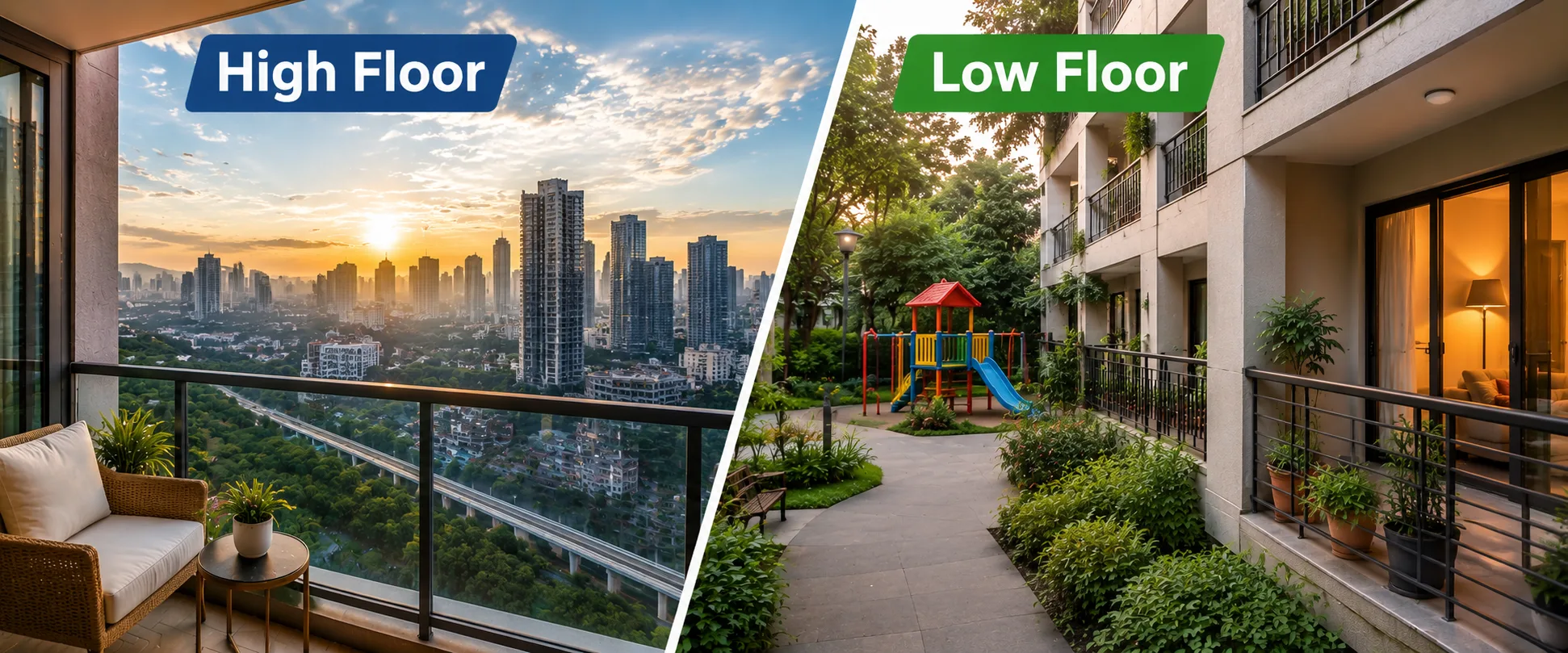
As I said, purchasing a condo is one of the largest consumer decisions you are going to make. While most homebuyers are concerned with location, reputation of the builder, and what amenities their house will offer, there is one significant component that tends to be overlooked: floor level.
Is it better to live in a flat with picturesque views on the higher floors, or in an apartment on a low floor that brings more convenience and faster access?
In reality, however, the argument between high floor vs low floor flat is a lot more than just an aesthetic matter. The floor you choose impacts pricing, maintenance, resale value, safety, ventilation, and even your day-to-day comfort.
If you ask what is the best floor to buy in an apartment, this article highlights ten practical differences most builders and brokers hardly ever talk about.
Is the Price Premium of High Floors Justified?
The price is usually one of the earliest differences noticed by buyers.
Most Indian developers charge floor rise charges — the rate per square foot goes up for every increase in floor level. This premium is generally ₹20–₹100 per sq. ft. per floor depending on the city, project category, and view.
Example:
If a builder charges ₹50 per sq. ft. as floor rise for your 1,500 sq. ft. apartment, moving up 10 floors — from the 5th to the 15th floor — can increase the total cost significantly.
Total Additional Cost: ₹50 × 1,500 × 10 floors = ₹7,50,000
Is It Worth It?
Paying the premium may be worth it if:
- There are unobstructed park, city, or green views from the unit.
- You value privacy and reduced noise.
- You plan to hold the property long term for appreciation.
However, if your view could eventually be blocked by future construction, paying a large premium may not make sense.
Noise Levels: High Floors Are Much Quieter
Low floors are more exposed to street noise, honking, and activities from amenities such as clubhouses and playgrounds.
Higher floors are generally quieter because they are farther away from:
- Roads and traffic
- Children’s play areas
- Generator rooms
- Security gates
If you work from home or simply prefer a peaceful environment, this can make a huge difference.
Ventilation and Natural Light
Higher floors usually perform better when it comes to airflow and sunlight.
High Floors:
- Better cross-ventilation
- More natural light
- Less obstruction from neighboring buildings
- Reduced dust and pollution
Low Floors:
- May face blocked sunlight
- Can feel more enclosed
- More exposure to dust and insects
However, orientation matters. A well-designed lower-floor apartment can sometimes perform better than a poorly oriented high-floor unit.
Water Pressure Can Be Better — or Worse
This is a practical issue that many buyers fail to consider.
Modern buildings rely on booster pumps and pressure management systems to maintain steady water supply. However, in projects with poor plumbing systems:
- Very high floors may experience pressure fluctuations if systems are not maintained properly.
- Lower floors may occasionally experience excessive pressure that damages fittings.
Before buying, ask:
- Does the building have a pressure boosting system?
- What is the backup power arrangement?
- How is plumbing maintenance handled?
Elevator Dependence
Living on higher floors means you become highly dependent on elevators.
Challenges include:
- Waiting during peak hours
- Lift maintenance downtime
- Power outages despite backup systems
Lower floors allow you to use stairs conveniently when needed.
This is especially important for:
- Senior citizens
- Families with young children
- People who dislike waiting for elevators
Fire Escape and Safety Perspective
Most buyers assume higher floors are safer because they are less accessible to intruders. That is true to an extent.
High Floors:
Pros
- Better security from unauthorized access
- Reduced flood risk
Cons
- Longer evacuation time during emergencies
- Greater reliance on fire systems and stairways
Low Floors:
Pros
- Faster emergency exit
- Easier access for elderly residents
Cons
- Slightly higher exposure to break-in attempts
Modern high-rises include features such as fire sprinklers, smoke detectors, refuge areas, and fire stairs, but lower floors still provide psychological comfort during emergencies.
Temperature and Energy Costs
The higher you go, the more sunlight and wind your apartment receives.
High Floors:
- Better airflow
- Can become hotter during summer
- Potentially higher air-conditioning costs
Low Floors:
- Usually cooler
- Less direct sun exposure
- Possibly lower cooling costs
In cities such as Noida, Gurugram, and Jaipur, western-facing high-floor apartments can become extremely hot during summer afternoons.
Which Floor Retains Better Resale Value?
Resale value is one of the most important considerations in floor selection.
High-floor apartments usually command better resale prices because they are perceived as premium properties due to:
- Better views
- Greater privacy
- Reduced noise levels
However, low floors also attract:
- Families with children
- Elderly buyers
- Budget-conscious purchasers
This means:
- Higher floors may achieve stronger premiums.
- Lower floors may sell faster due to affordability.
Real estate professionals often observe that higher floors command stronger pricing, while lower floors offer better resale liquidity.
Vastu Considerations for Floor Selection
From a Vastu perspective, the floor number itself is usually less important than:
- Entrance direction
- Kitchen location
- Bedroom placement
- Balcony orientation
That said, some buyers believe:
- Mid floors have a balanced energy profile.
- Lower floors feel more connected to the earth element.
- Higher floors feel less grounded.
In practical Indian real estate markets, a Vastu-compliant layout matters more than whether the flat is on the 4th or 14th floor.
Lifestyle and Family Suitability
The ideal floor depends largely on who will live in the apartment.
High Floors Are Ideal For:
- Professionals and couples
- Buyers seeking views and privacy
- Long-term investors
- People comfortable with elevator dependence
Low Floors Are Best For:
- Families with children
- Senior citizens
- Buyers prioritizing convenience
- People with vertigo or acrophobia
Mid Floors: The Often Perfect Balance
The 5th to 12th floors often provide the best overall balance for many buyers in terms of:
- Reasonable pricing
- Good ventilation
- Moderate lift dependence
- Strong resale appeal
Which Floor Is Best to Buy in an Apartment?
If you are still deciding which flat is best to buy in an apartment, focus on your priorities.
Choose a High Floor If You Want:
- Scenic views
- Privacy
- Better airflow
- Premium resale appeal
Choose a Low Floor If You Want:
- Easy access
- Lower cost
- Faster emergency exit
- Better suitability for elderly family members
If you want the best all-round balance, consider a mid-floor apartment.
Final Thoughts
There is no universally right or wrong answer in the high floor vs low floor flat debate. The ideal choice depends on your budget, family needs, lifestyle, and long-term investment goals.
Higher floors may offer prestige, quieter living, and stronger resale premiums, while lower floors provide practicality, affordability, and peace of mind during emergencies.
Before making your final decision, visit the unit at different times of the day, inspect the lift and fire safety infrastructure, and verify the actual view and ventilation rather than relying only on marketing brochures.
The best floor is ultimately the one that suits your lifestyle — not just the one that looks impressive on paper.